The 1st Utterance of Jesus Christ on the Cross
Article #3 on the 7 Utterances of Jesus Christ on the Cross
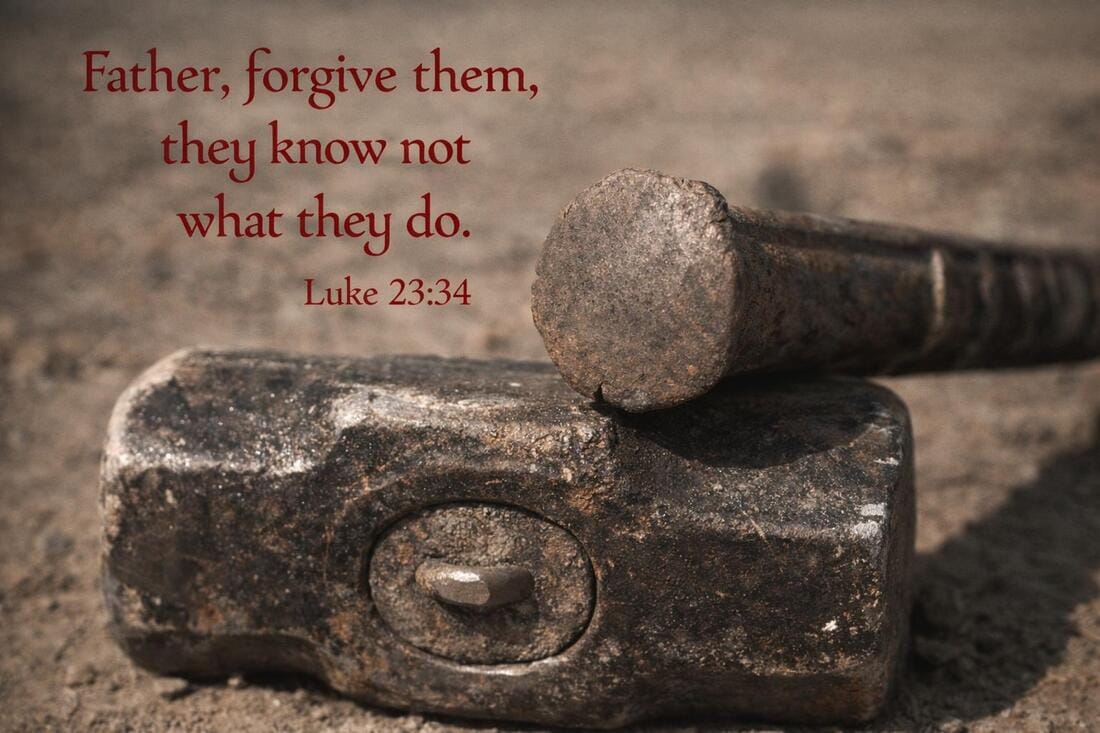
“Father, forgive them;
for they know not what they do.”
– Luke 23:34
This intercessory prayer was louder than thunder. It shook the third Heaven! It struck deep into the holy heart of the Father. “For He hath not despised nor abhorred the affliction of the afflicted; neither hath He hid His Face from Him; but when He cried unto Him, He heard.” (Ps. 22:24). So far from desertion, what we are seeing here is triumphant intercession! “He…made intercession for the transgressors.” (Isa. 53:12). Literally, this prayer was recorded in the courtroom of Heaven as new legislation, effectively creating a law of redemption, because justice was being served upon sinners in real time through the suffering of Jesus Christ on the Cross.
Blotting outagainstcontrarynailing it to His Cross
The Son asked…and the Father gave! As it was written (Ps. 2:8). This prayer, “Father, forgive them” (Lk. 23:34), was heard by God from the earthly altar of the Cross (Heb. 13:10-13), as if it was prayed at the golden altar of incense in the third Heaven (Rev. 6:9, 8:3, 5, 9:13, 14:18, 16:7) – a mighty and angelic altar that had horns like those of ancient unicorns (Ps. 22:21, Job 39:9-12). This prayer was answered, and now Heaven is filled with millions of sinners who were freely forgiven by God as they believed upon Jesus Christ.
And sitting down they watched him there
And the people stood beholding
And they that passed by reviled him, wagging their heads
Curious, like an assembly of demons, everyone was watching, but most people weren’t seeing what was really happening. Recklessly, like a frenzy of stampeding bulls, the crowd kept growing with people who wanted to insult and intimidate the King of the Jews. Ravenous, like lions, the eyes of these sinful souls were feeding on the gory scene. Exalting themselves, like roaring lions, obnoxiously, like barking dogs, these people roared and barked their insults at the sinless Savior.
bullscompassedbullsbesetgapedraveningroaringlion
dogscompassedthey pierced My hands and My feetI may tell all My bones: they look and stare upon MeMy garmentsMy vesture
The Almighty’s flesh was emaciated. The body of God-incarnate was dehydrated. The Holy One of Heaven was naked and dying on earth like a condemned criminal. Struggling to breath, as the body of Jesus Christ was stretched and nailed in a hanging position, our Lord says, “I may tell all My bones: they look and stare upon Me.” (Ps. 22:17). The very bones of our dying King were visibly exposed before the feasting eyes of animalistic sinners.
A purposeful connection is being made between Psalm 22:12-13 and Psalm 22:16. The human depravity being put on display was so outrageous, Christ was compelled to call His persecutors bulls, lions, and dogs. They were acting like wild and immoral animals. This is a well-known doctrine in the Bible (2 Pet. 2:12, Jude 1:10). Sinners experience an animalistic degeneration when they are demon possessed (Matt. 7:6, 12:45, Rev. 18:2, Lk. 22:3, Jn. 13:2, 27).
Thou that destroyest the Temple, and buildest it in three days, save thyselfIf thou be the Son of God, come down from the crosssavedsaveHe trusted in God; let him deliver him now, if he will have him
Ah, thou that destroyest the Temple, and buildest it in three days, Save thyself, and come down from the crosssavedsave
savedsave
According to the chronology provided in Luke 23:33-38, immediately following our Lord’s prayer of intercession, the people proceeded to revile, mock, scorn, and challenge Jesus Christ. Their challenge is a part of a growing controversy that began in the early days of Christ’s ministry. Upon cleansing the Temple, the Jews scornfully asked for a sign in a pretentious quest for faith (Jn. 2:13-25). The answer given deeply offended the Jews.
signDestroy this Temple, and in three days I will raise it upJn. 2:18-19
Jews from various regions repeatedly asked for a sign in the same manner, so the Lord ended up elaborating upon the same answer again and again (Matt. 12:38-40, Lk. 11:29-32). Even the most infamous adversaries of Jesus were all given the same sign (Matt. 16:1-5; Mk. 8:11-15). However, the Jews completely misunderstood what Jesus Christ was saying in the sign. Our Lord’s words were interpreted as a threat because the Jews thought He was talking about the destruction of the Jewish Temple.
The Jews were sure that the Man couldn’t destroy the Temple and rebuild it in three days, so they took it upon themselves to slanderously promoted this sign as proof that Jesus Christ was a false prophet and worthy of death. This is why His accusers brought up this sign before the Sanhedrin as they sat in judgment to condemn Jesus Christ to death (Matt. 26:61). Upon being crucified, the Jews mocked Jesus Christ by challenging Him to perform the same sign as proof of His Messianic Identity (Matt. 27:36-44, Mark 15:26-32). However, to do so, He would have to come down from the Cross, so their challenge evolved into this: “Let Christ the King of Israel descend now from the cross, that we may see and believe.” (Mk. 15:31). In the eye of a blind beholder, Jesus Christ appeared to be utterly forsaken of God as He roared in torment, being rightly condemned as a false prophet.
Why art Thou so far from helping Me, and from the words of my roaring?”
The offended spectators needed an interpretation. Therefore, this question was both asked and answered in Psalm 22: “Why?”. The word, “helping”, in Psalm 22:1, is literally speaking about the “saving help” of God the Father. This comes through in the Hebrew because the word “yeshua” was being used (H3444). Hebrew readers would easily recognize this fact as they are familiar with Psalm 22. Indicating this, the ESV translates this verse, “Why are You so far from saving Me, from the words of My groaning?” (Ps. 22:1b).
Remember, the scornful challenge of the Jewish unbelievers was, “save Thyself” (Matt. 27:40, Mk. 15:30, Lk. 23:37), and by this they meant, “If thou be the Son of God, come down from the Cross.” (Matt. 27:40, Mk. 15:30). Again, they said, “He saved others; Himself He cannot save.” (Matt. 27:42, Mk. 15:31, Lk. 23:35). This challenge is also recorded in Psalm 22. The Jews said, “He trusted on the LORD that He would deliver Him: let Him deliver Him, seeing He delighted in Him.” (Ps. 22:8). Hour by hour, from the 6th to the 9th hour, the Jews kept looking to see if Jesus will in this manner be saved from the Cross, thinking that maybe even Elijah will come to “save” Jesus Christ (Matt. 27:49). Even the impenitent Thief on the Cross said, “If Thou be Christ, save Thyself and us.” (Lk. 23:39).
Historically, in context, we can see the relevance of the question posed by Jesus Christ, “Why art Thou so far from helping / saving Me, and from the words of My roaring?” (Ps. 22:1b). The same can be said about the question, “My God, My God, why hast Thou forsaken Me?” (Ps. 22:1a). Of course, the Son of God anticipated this very moment of controversy and gave the following public clarification with a thunderous answer from Heaven.
‘Father, save Me from this hour’?“I have glorified it, and I will glorify it again.”thunderedAnd I, when I am lifted up from the earth, will draw all people to myselfdeath
In retrospect, we can all see why God wasn’t minded to help Jesus Christ by saving Him from the Cross. The Son of God would not dare to pray for God to save Him from the Cross. As stated, this would defy the very purpose that He was born. Instead of saving Himself from the Cross, our Lord was pleased to “save the world” by the Cross (Jn. 12:47). Nevertheless, let it be known that Christ did pray for God’s “help” two times while being tortured to death on the Cross, as recorded in Psalm 22 – once in Psalm 22:11 and second time in Psalm 22:19. Those prayers for “help” were heard by God and answered, according to the testimony of Psalm 22:19-31, to be declared in due time. That being said, the crucifixion scene must run its course until the Son of God expires in death. The Hind of the Morning, being bitten and torn by wild animals, must expire in death while appearing defenseless and helpless before the scornful eyes of spectators.
Notice how David entitled Psalm 22, “Aijeleth Shahar”. Being interpreted, this means, “The Hind of the Morning”. A female deer feeding on the grassy hills of Zion at dawn is a beautiful sight. That being said, when the hind is caught by predatory lions and dogs, it is totally defenseless and helpless…and doomed to die. The Son of God, the darling of the Father, is this defenseless Hind in the dawn of the Atonement. God will not save the Hind! Like a tender and defenseless “Lamb” it must be led to the slaughter (Jn. 1:29, 36).
Nobody, except perhaps John the Baptist, was expecting this to happen to the King of the Jews. Our Lord’s closest disciples were immediately offended when they first heard about the Cross (Matt. 16:21-23). The same men personally heard the agonizing cries of Jesus Christ in the Garden of Gethsemane and at the Cross, and they were offended at how He seemed abandoned by God and given over to distress (Ps. 22:1-2). Of course, they didn’t understand the internal conflict of Jesus Christ in Gethsemane, nor how it was righteous for the Son of God to feel this way, both in the Garden and at the Cross.
They were confused to see the Messiah drenched in bloody sweat and praying, “Let this cup pass from Me” (Matt. 26:39), while knowing that the Father refused to answer this prayer. They never heard anything like this before as they lived and prayed with Jesus Christ for three years (Ps. 22:2). They never observed Christ in conflict with the Father at any time. They were expecting Christ to grow stronger and stronger both privately and publicly, and they had biblical and historical reasons for this expectation.
It was the duty of the Kings of Israel to go to war and vanquish the holy land of sinners (Ps. 101). This expectation is biblical and historical, but it was misplaced in respect to the 1st Advent of Christ. The timing was wrong. A thrice holy God demanded a sacrifice first of all (Ps. 22:3)! Divine love thought it good to die for sinners before annihilating them. Therefore, rather than exaltation, Christ was called to humiliation. Rather than glorification, Christ was bound by nails to the Tree of condemnation, much to the delight of the enemies of God.
wormreproachdespisedlaughscornshake the head
Being utterly given over to the “scorn” and “reproach” of sinners, Jesus Christ appeared worthless and contemptible like a “worm” before the enemies of God. The faith of the disciples was dashed to pieces as the Hind of the Morning was torn to shreds before their very eyes. But the sinless Son of God was still precious and invaluable to God the Father. Jesus Christ was the first Man since the Fall to be born sinless, and we can be sure that He will die sinless (Ps. 22:9-10). Consequentially, the Man wasn’t dying for His own sins on the Cross of Rome.
The eternal Son – born to die - became a Man and courageously faced His destiny. “I gave My back to the smiters, and my cheeks to them that plucked of the hair: I hid not my face from shame and spitting.” (Isa. 50:6). Nevertheless, the scattering of His disciples was disappointing, and a cause for lamentation (Isa. 49:4).