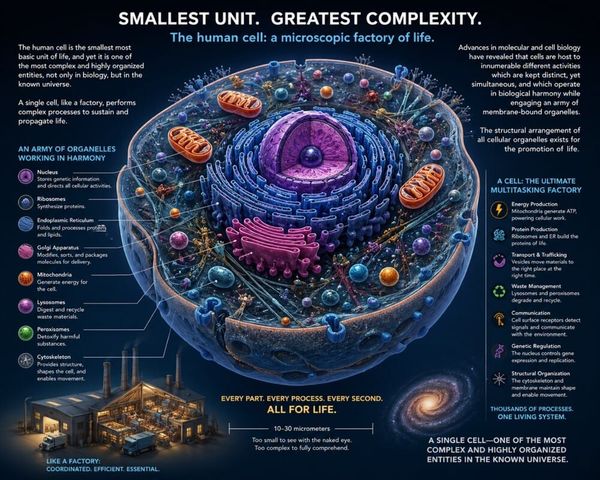
The Human Brain is the Most Sophisticated Authoritative Computational Information Network in the Physical Universe
Article #6 on Atheism
(Author: Preethi David Morris, PhD Researcher)
The human brain is widely regarded as a superstructure that far exceeds any other functional information processing and integration system in the universe. The scope of information that the brain can receive is unquantifiable, including quantitative and qualitative components that allow a person to survive, grow, learn, think, feel, move, work, know, will, serve, and much more. As the mastermind of human life, the vast majority of the human brain functions outside of conscious awareness, with conscious thinking and acting only the “tip of the iceberg” or the “outer skin” of a massive underlying system. The organ operates internally (central nervous system (CNS)) and both controls and receives input from the entire body (peripheral nervous system (PNS)). Complex information reception, analysis, and integration with a full-range of feedback loops far exceeds the nervous system of any other creature. The human brain is host to approximately 100 billion neurons, which form connections with other neurons through 10¹⁴–10¹⁵ synapses, which entail a rich computational network. Only an omniscient Godhead with eternal power could create this superstructure that executes processes of cognition whereby man has the unique ability to know God.
O the depth of the riches both of the wisdom and knowledge of God! how unsearchable are his judgments, and his ways past finding outFor who hath known the mind of the Lord? or who hath been his counsellor?
Afferent Connections
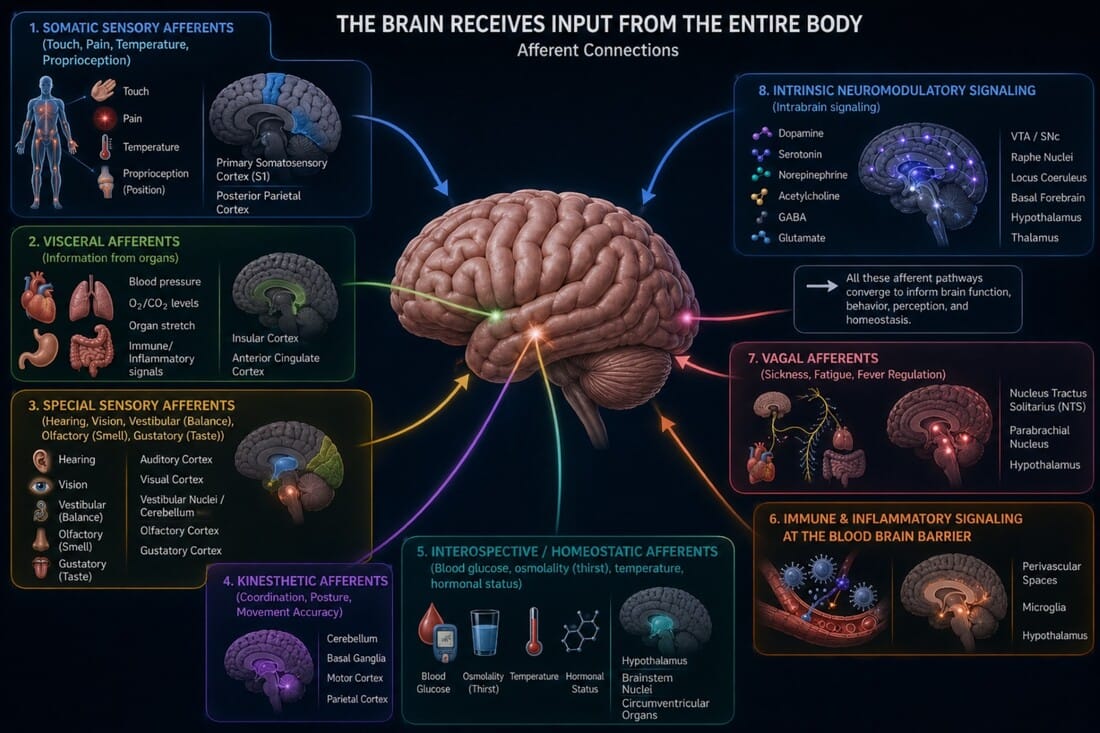
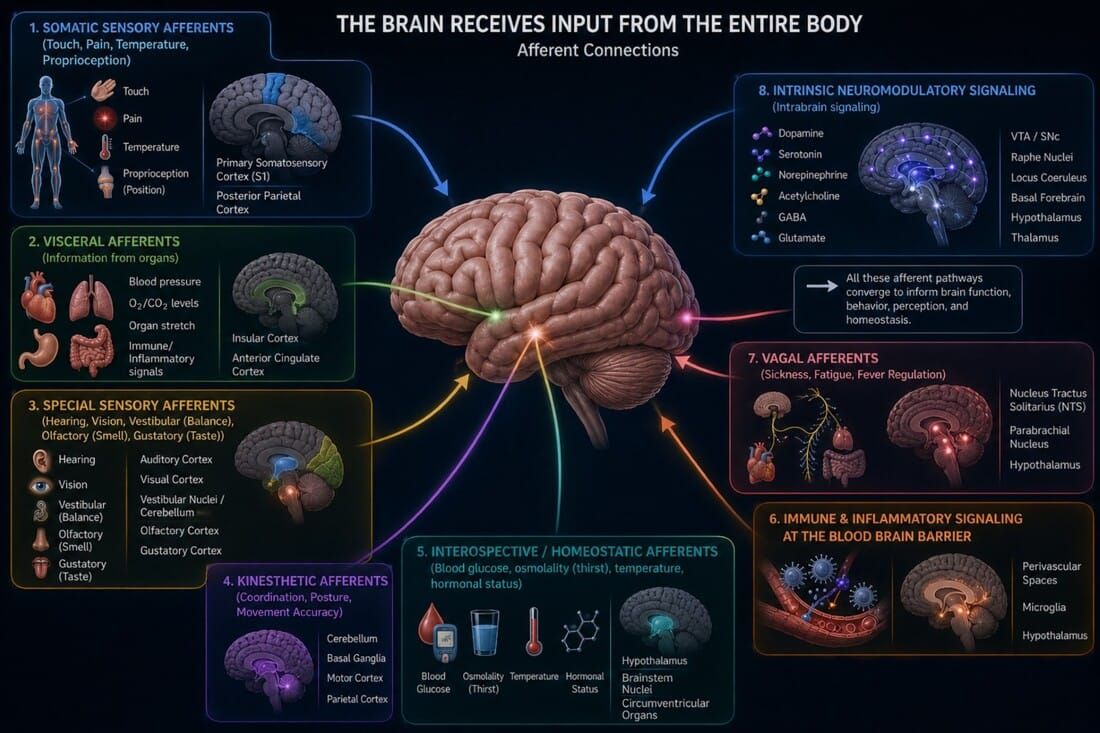
The brain receives input from the entire body in the form of afferent connections. These include somatic sensory input (touch, pain, temperature, proprioception (position)), visceral afferents (information from organs: blood pressure, O2/CO2 levels, organ stretch, immune/inflammatory signals), special sensory afferents (hearing, vision, vestibular (balance), olfactory (smell), gustatory (taste)), Kinesthetic afferents (coordination, posture, movement accuracy), Interoceptive/Homeostatic afferents (blood glucose, osmolality (thirst), temperature, hormonal status), immune and inflammatory signaling at the blood brain barrier and vagal afferents (sickness, fatigue, fever regulation), and intrinsic neuromodulatory signaling (intrabrain signaling).
Efferent Connections
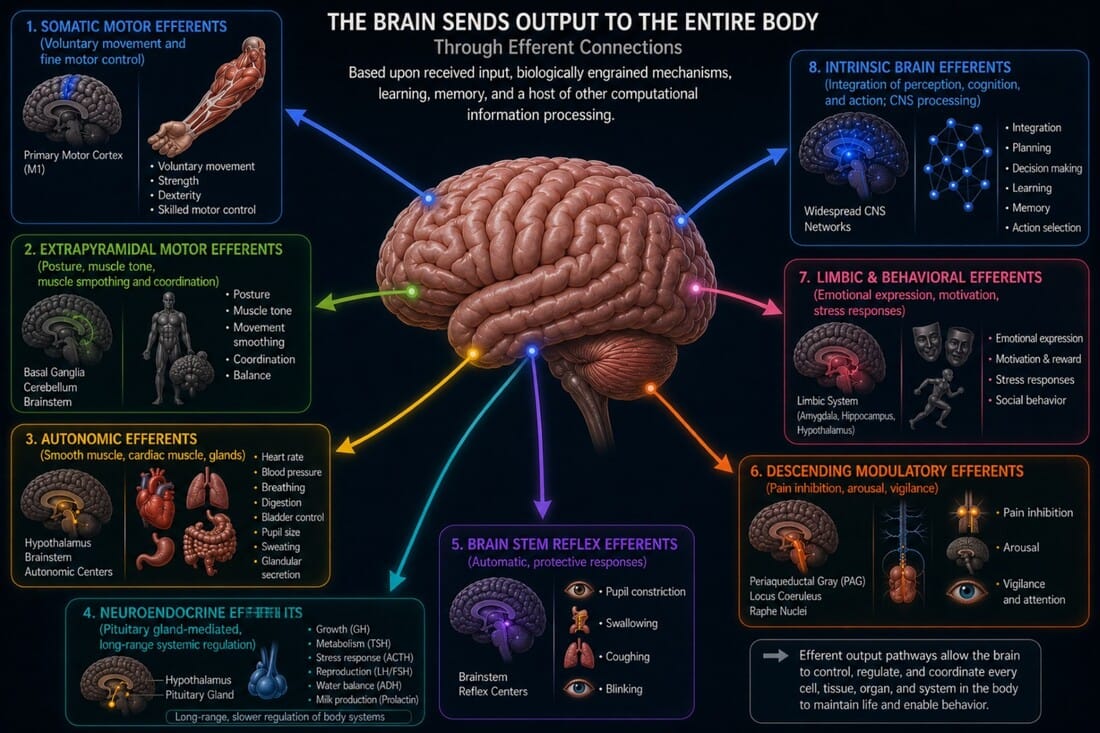
The brain sends output to the entire body through efferent connections based upon received input, biologically ingrained mechanisms, learning, memory, and a host of other computational information processing. Somatic motor efferents control voluntary movement and fine motor control. Extrapyramidal motor efferents control posture, muscle tone, and muscle coordination. Autonomic efferents control smooth muscle, cardiac muscle, and glands. Neuroendocrine efferents from the pituitary gland promote long-range, slower systemic regulation, growth, metabolism, and reproduction. Brainstem reflex efferents control pupil constriction, swallowing, coughing, and blinking. Descending modulatory efferents execute pain inhibition, arousal, and vigilance. Limbic and behavioral efferents execute emotional expression, motivation, and stress responses. Finally, intrinsic brain efferents perform integration of perception, cognition, and action, as well as concerted CNS processing.
Systems of the Brain
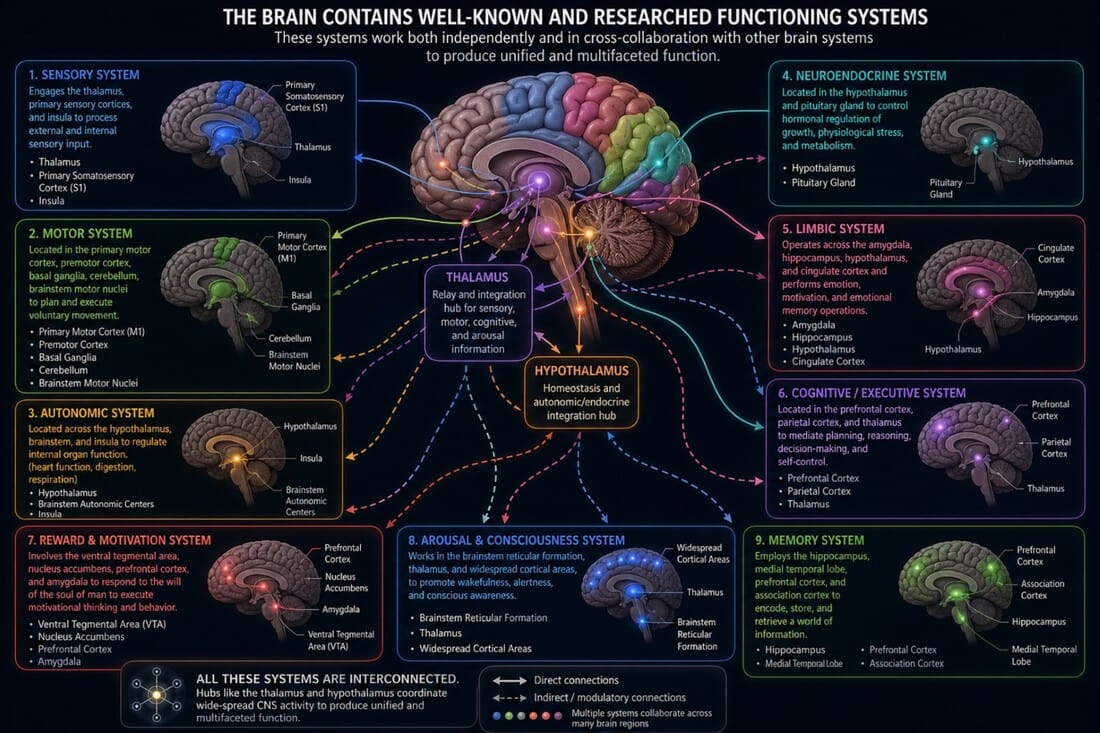
The brain contains well-known and researched functioning systems which work both independently and in cross-collaboration with other brain systems. The sensory system engages the thalamus, primary sensory cortices, and insula to process external and internal sensory input. The motor system located in the primary motor cortex, premotor cortex, basal ganglia, cerebellum, brainstem motor nuclei plans and executes voluntary movement. The autonomic system located across the hypothalamus, brainstem, and insula regulates internal organ function (heart function, digestion, respiration). The neuroendocrine system located in the hypothalamus and pituitary gland controls hormonal regulation of growth, physiological stress, and metabolism. The limbic system operates across the amygdala, hippocampus, hypothalamus, and cingulate cortex and performs emotion, motivation, and emotional memory operations. The cognitive/executive system located in the prefrontal cortex, parietal cortex, and thalamus mediates planning, reasoning, decision-making, and self-control. The reward and motivation system in the ventral tegmental area, nucleus accumbens, prefrontal cortex, and amygdala responds to the will of the soul of man to execute motivational thinking and behavior. The arousal and consciousness system works in the brainstem reticular formation, thalamus, and widespread cortical areas to promote wakefulness, alertness, and conscious awareness. The memory system employs the hippocampus, medial temporal lobe, prefrontal cortex, and association cortex to encode, store, and retrieve a world of information! All these systems are interconnected, and hubs like the thalamus and hypothalamus coordinate wide-spread CNS activity to produce unified and multifaceted function.
The Spinal Cord
The brain consolidates information from central hubs and connects to the spinal cord through the brain stem. Ascending pathways communicate sensory information to the thalamus and cortex, while descending pathways control spinal activity. The brain consolidates input across cortical, thalamic, and cerebellar systems to facilitate perception, coordination, and adaptive motor control that is perpetually modulated with feedback from the spinal cord. The spinal cord is organized into segments and contains about 10-20 million neurons. Gray matter (dorsal sensory, ventral motor, and lateral autonomic horns) are surrounded by white matter tracts. Afferent fibers containing somatic and visceral information come into the cord via dorsal roots. Efferent fibers leave the cord through ventral roots to muscles and organs. The 31 pairs of spinal nerves branch off segmentally from the spinal cord along its entire length with each pair originating from a specific spinal cord segment. At each level dorsal sensory roots and ventral motor roots energy from the cord and join to form a mixed spinal nerve, and exit the vertebral column. The spinal cord segments are organized as follows: 8 cervical (C1-C8)—exit in the neck region, 12 thoracic (T1-T12)—exit below their corresponding vertebrae, 5 lumbar (L1-L5)—lower back, 5 sacral (S1-S5)—pelvis, 1 coccygeal (Co1)—tailbone region. The spinal nerves form branches into dorsal and ventral rami delivering sensory and motor innervation to the entire body.

Neurons in the spinal cord transport neurotrophic growth factors along their axons using anterograde and retrograde transport via kinesin and dynein. These molecules promote neuronal survival, synaptic plasticity, regeneration, and circuit maintenance. In parallel, the spinal cord contains a rich supply of blood vessels allowing systemic hormones to diffuse into spinal tissue and facilitate functions such as metabolism, stress response, autonomic output, and neuronal excitability.
The Megaoperation of Human Consciousness
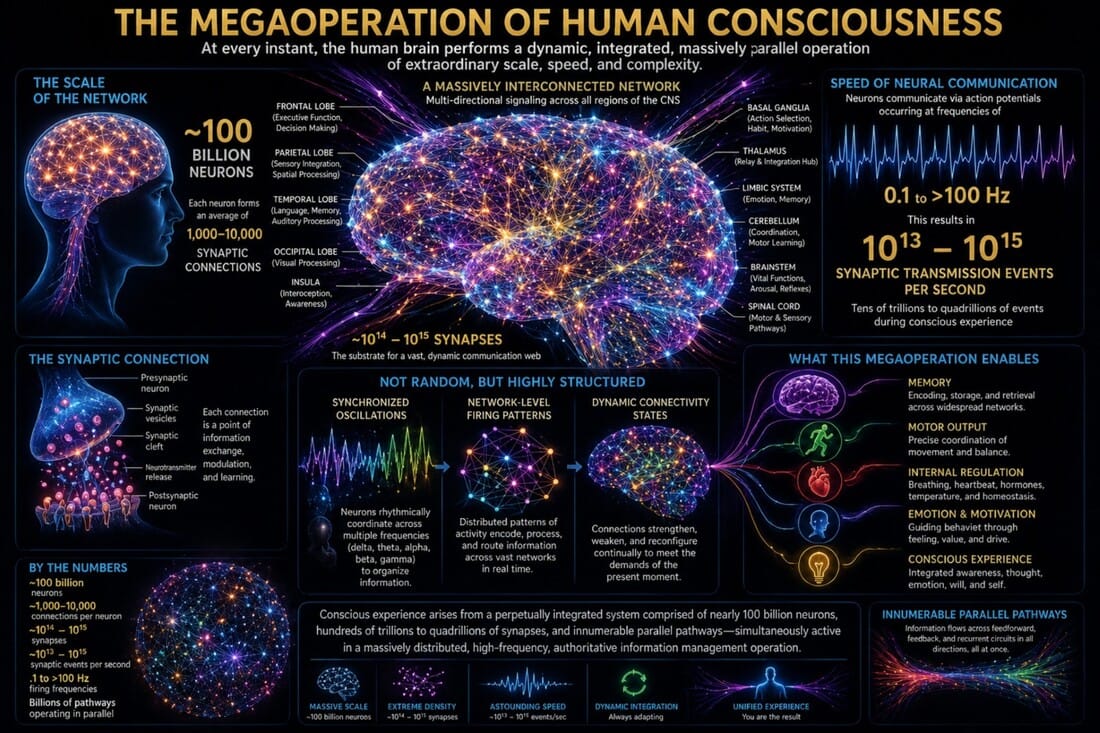
At any given instant of human consciousness, the brain is operating in an extraordinarily dense, simultaneously-working network consisting of nearly 100 billion neurons. Each neuron forms an average of 1,000-10,000 synaptic connections, resulting in approximately 10¹⁴–10¹⁵ synapses. These synapses are harnessed by vast interconnecting pathways that enable multi-directional signaling across all regions of the CNS. Neurons communication through action potentials occurring at frequencies of 0.1 to >100 Hz which translates to tens of trillions to quadrillions of synaptic transmission events per second during human consciousness. This dynamic megaoperation is not random but highly structured featuring synchronized oscillations, network-level firing patterns, and shifting connectivity states for coordination of memory, motor output, and internal regulation within time. Thus, conscious experience arises from a perpetually integrated system comprised of innumerable parallel pathways that are simultaneously active in massively distributed, high-frequency authoritative information management.
“So God created man in his own image, in the image of God created he him; male and female created he them.
CNS Support of Whole Body Growth and Nourishment
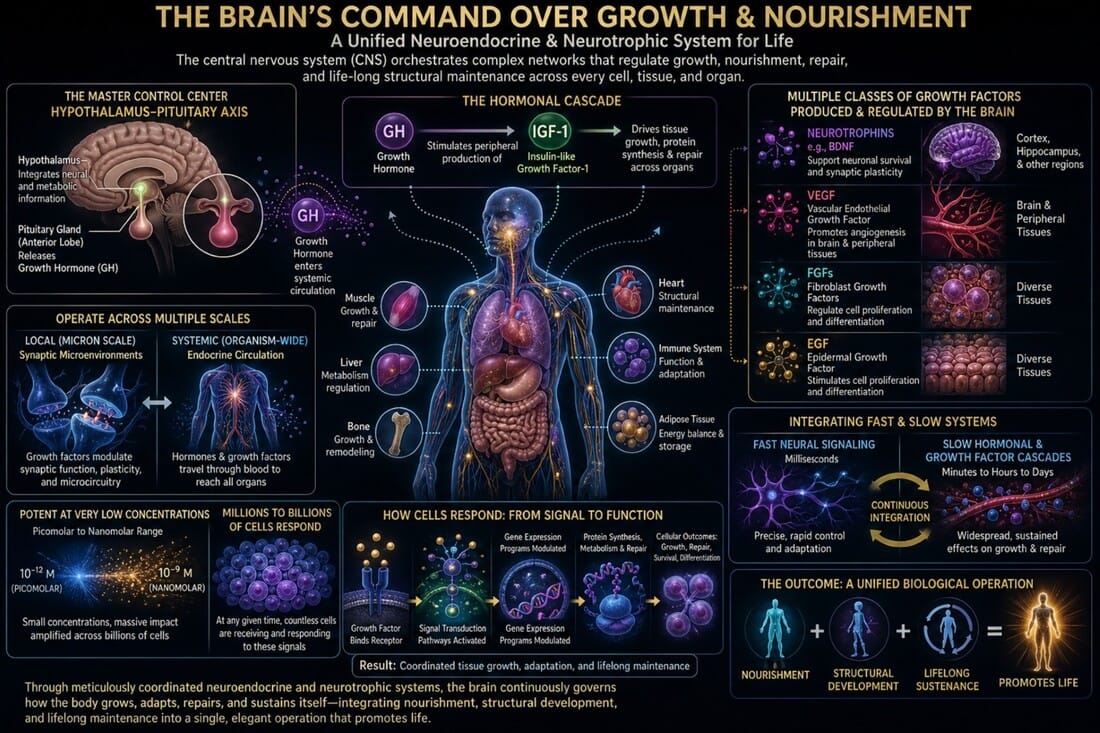
Among the profuse number of operations controlled by the CNS, the brain supports the growth and nourishment of the body through meticulously coordinated neuroendocrine and neurotrophic systems. These systems regulate cellular proliferation, metabolism, repair, and life-long structural maintenance. The main control center is the hypothalamus-pituitary axis, which releases growth hormone (GH). GH stimulates peripheral production of insulin-like growth factor-1 (IGF-1), which is a key driver of tissue growth and protein synthesis across organs. Additionally, the brain produces multiple classes of growth factors such as neurotrophics (e.g. brain-derived neurotrophic factor (BDNF)), fibroblast growth factor (FGFs), vascular endothelial growth factor (VEGF), and epidermal growth factor (EGF)). These growth factors act in specific regions. Neurotrophics support neuronal survival and synaptic plasticity in the cortex and hippocampus. VEGF promotes angiogenesis in the brain and peripheral tissues. FGFs and EGFs regulate cell proliferation (multiplication) and differentiation (the biological process where unspecialized stem cells mature into distinct, specialized cell types) across diverse tissues. These factors operate on the micron scale in local synaptic microenvironments as well as an organism-wide scale involving systemic endocrine circulation. Concentrations in the picomolar to nanomolar range have effects which are amplified across billions of cells. At any given time, millions to billions of cells are responding to these signals. Gene expression programs downstream of growth factor receptors modulate protein synthesis, metabolism, and repair processes. This multifaceted employment of both fast neural signaling with slower but widespread hormonal and growth factor cascade allows the brain to continuously control how the body, grows, adapts, and sustains itself. Therefore, nourishment, structural development, and lifelong sustenance are integrated into a unified biological operation that promotes life.
But speaking the truth in love, may grow up into him in all things, which is the head, even Christ: From whom the whole body fitly joined together and compacted by that which every joint supplieth, according to the effectual working in the measure of every part, maketh increase of the body unto the edifying of itself in love
If the brain were not coordinating growth and nourishment through its neuroendocrine and neurotrophic system, the body would lose this centralized regulation of organized development and growth, metabolic balance, and tissue maintenance. Without the presence of the hypothalamus-pituitary gland axis, the absence of growth hormones, thyroid hormones, and cortisone would result in systemic protein synthesis, abnormal energy utilization, and organ failure. IGF-1, FGFs, and VEGF attenuation would result in insufficient or absent cellular proliferation causing atrophy, delayed development, and poor repair, or uncontrolled proliferation as in tumorigenesis. Organs would no longer receive synchronized signals that assess nutrient availability and demand. This would result in failure in glucose homeostasis, immune regulation, and vascular maintenance. Within time, this would manifest broadly in physiological disintegration: stunted or disproportionate growth, failure of tissue regeneration, metabolic collapse, and loss of ability to maintain homeostasis. In effect, without the brain’s integrative control, the human body would lose the system-wide coordination needed for sustaining and supporting development, sustenance, and growth!
And not holding the Head, from which all the body by joints and bands having nourishment ministered, and knit together, increaseth with the increase of God
References:
Azevedo, Frederico A. C., et al. “Equal Numbers of Neuronal and Nonneuronal Cells Make the Human Brain an Isometrically Scaled-Up Primate Brain.” Journal of Comparative Neurology, vol. 513, no. 5, 2009, pp. 532–541.
Buzsáki, György. Rhythms of the Brain. Oxford University Press, 2006.
Carmeliet, Peter. “VEGF as a Key Mediator of Angiogenesis in Cancer and Other Diseases.” Nature Medicine, vol. 9, no. 6, 2003, pp. 653–660.
Herculano-Houzel, Suzana. “The Human Brain in Numbers: A Linearly Scaled-Up Primate Brain.” Frontiers in Human Neuroscience, vol. 3, 2009, article 31.
Herculano-Houzel, Suzana. “Numbers of Neurons as Biological Correlates of Cognitive Capability.” Current Opinion in Behavioral Sciences, vol. 16, 2017, pp. 1–7.
Huang, Eugene J., and Louis F. Reichardt. “Neurotrophins: Roles in Neuronal Development and Function.” Annual Review of Neuroscience, vol. 24, 2001, pp. 677–736.
Kandel, Eric R., et al. Principles of Neural Science. 5th ed., McGraw-Hill, 2013.
Laughlin, Simon B., and Terrence J. Sejnowski. “Communication in Neuronal Networks.” Science, vol. 301, no. 5641, 2003, pp. 1870–1874.
Le Roith, Derek, et al. “The Somatomedin Hypothesis: 2001.” Endocrine Reviews, vol. 22, no. 1, 2001, pp. 53–74.
Melmed, Shlomo, et al. Williams Textbook of Endocrinology. 14th ed., Elsevier, 2020.
Purves, Dale, et al. Neuroscience. 6th ed., Oxford University Press, 2018.
Sherwood, Clifford C., et al. “Evolution of the Brain.” The Human Nervous System, 3rd ed., edited by George Paxinos and Juergen K. Mai, Elsevier, 2012, pp. 3–18.
von Bartheld, Christopher S., et al. “The Search for True Numbers of Neurons and Glial Cells in the Human Brain: A Review of 150 Years of Cell Counting.” Journal of Comparative Neurology, vol. 524, no. 18, 2016, pp. 3865–3895.