The High Priest of the Old Testament
Article #2 on Seeing Christ in a Theater of Typology
The Mediator, the High Priest, the Holy of Holies, & the Unapproachable Light!
Amazingly, the ministry of the Mediator would become even more visible once the Tabernacle was in operation. Do you remember the “face to face” communion that Moses experienced in the makeshift Tabernacle of Exodus 33:11? This was a sign of good things to come when a legally sanctioned and consecrated Tabernacle was finally constructed (Exodus 34:33-35)! This will prove to be true for the Mediator and the High Priest. Consequentially, it will soon be necessary for the congregation of Israel to come face to face with the High Priest, in one “holy convocation” in particular (Lev. 23:27), similar to how the people were required to have relations with their Mediator at Sinai.
Comprehending the distinct roles of these two Offices, their relationship to each other, and their ability to have face to face meetings with God in the Tabernacle, is essential to Christology. God was setting a stage for a theater of typology so believers could look back and learn about Jesus Christ! However, at the time in history, Israel had no idea what was going on, because none of them had ever built a Tabernacle before. Nor did the people ever have a relationship with God that was dependent upon a Priesthood and their ministry at the Tabernacle. This realization would come in spectacular fashion. The completion of the Tabernacle, and its consecration, was accompanied with signs and wonders to prove to the people that a successful transition of glory from Sinai to the Tabernacle had been accomplished. Let us carefully observe how this happened and what lessons are to be learned in the process.
A Successful Transition of Glory from Sinai to the Tabernacle
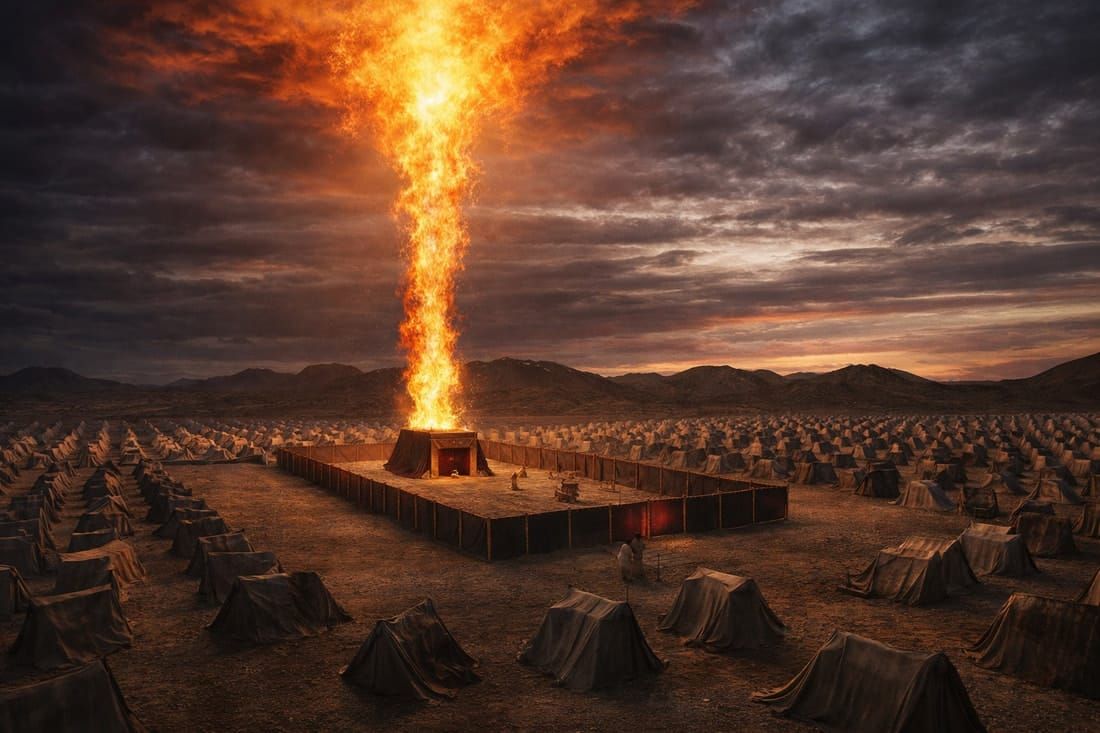
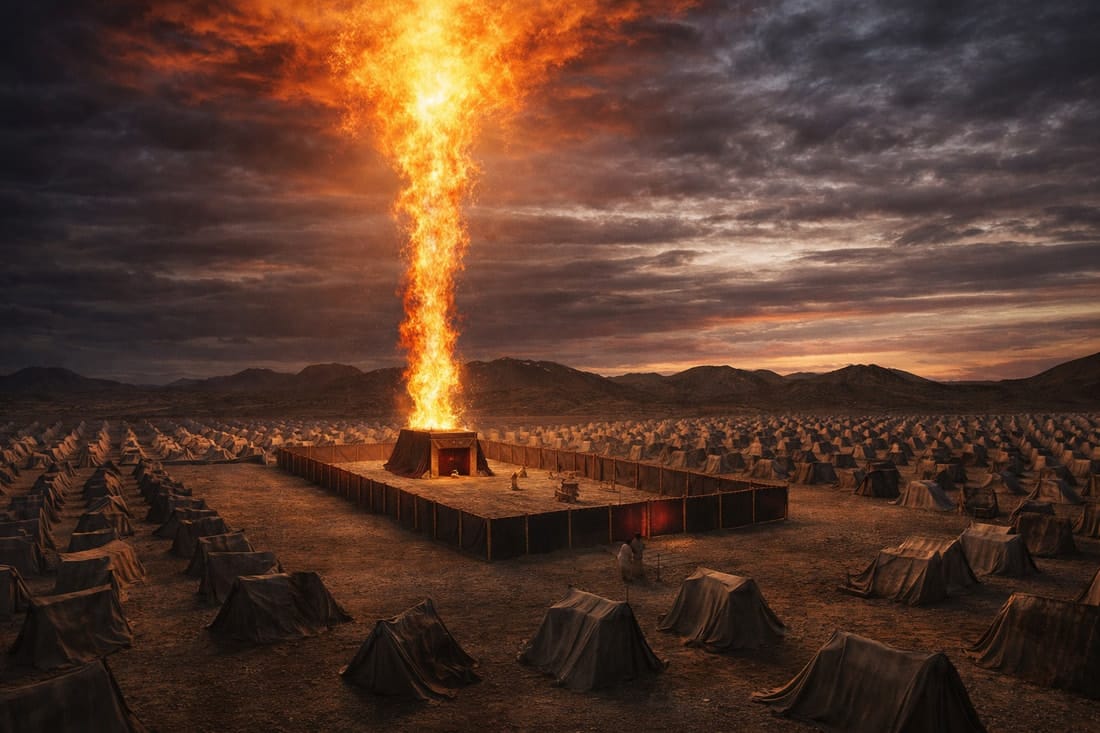
Ultimately, fire came out from before the LORD and consumed the sacrifice of the altar at the door of the Tabernacle (Lev. 9:24)! This symbolized the satisfaction of the wrath of God (“…when all the people saw, they shouted, and fell on their faces.” – Lev. 9:24).
Ultimately, a cloud covered the tent of the congregation, and “the glory of the LORD” filled the Tabernacle, insomuch that not even Moses was able to enter the Tabernacle until the presence of the glory was diminished (Ex. 40:34-35)! This symbolized the sanctification of the Tabernacle (Ex. 29:42-46).
Ultimately, face to face encounters began and continued to happen in the Holy of Holies of the Tabernacle (Ex. 25:22, 30:6, 36, 34:33-35; Lev. 9:4, 6, 23-24, 10:1-2, 16:1-2, 12-17; Lev. 1:1, Num. 7:89).
Moses received instructions on how he and the Priesthood should offer all the necessary sacrifices as each occasion would require (Lev. 1:1-7:38). These instructions were necessary to successfully offer the needed sacrifices on this glorious day, namely, when the operation of redemption would begin at the Tabernacle (Ex. 40, Lev. 9, Num. 7). Upon executing the careful instructions given for the consecration of the Priesthood, so that Aaron and his sons could officially begin their ministry (Lev. 8:1-36), the Priests then began to minister in the Sanctuary of the Tabernacle alongside Moses (Ex. 40:31-33, Lev. 9:1-24).
A Tour of the Tabernacle
If everything was accomplished successfully, then the LORD promised to “dwell among” the congregation of Israel by inhabiting the Tabernacle (Ex. 25:8). This would allow everyone in Israel to meet with God respectively in three different places: (1) in the Courts of the LORD at the door of the Tabernacle of the Congregation, (2) in the Sanctuary of the Tabernacle before the Vail, and (3) in the Holy of Holies behind the Vail at the Mercy Seat. Let us begin out tour of these places at the door of the Tabernacle of the Congregation.
The Courts of the LORD at the Door of the Tabernacle of the Congregation
at the door of the Tabernacle of the Congregation before the LORDwhere I will meet you, to speak there unto theeAnd there I will meet with the children of Israel
Common Israelites were welcome to meet with God in a special way by coming to pray in the Courts of the LORD. Also, whenever necessary, they would come “before the LORD” unto the altar for the offering of sacrifices “at the door of the Tabernacle of the Congregation” (Lev. 1:3, 3:2). This is a place of presentation for forgiveness and cleansing (Lev. 14:11, 16:7). This is also a place where God would speak to the Israelites who were coming before the LORD with their matters, usually by the Priesthood preaching and teaching from the Word of God, but also by prophetic utterance (Mal. 2:5-7, Deut. 33:8-10, 1 Sam. 1:17). Furthermore, in extraordinary circumstances, the LORD would appear “at door of the Tabernacle of the Congregation” in a visible manifestation of glory to speak and perform miraculous exploits of divine judgement (Ex. 33:9-11, Num. 12:5, 14:10, 16:19, 42, 50, 20:6).
The Sanctuary of the Tabernacle
Even the Kings of Israel would resort to the Priesthood to hear from God as the need required, because the Priests wore the Ephod and only they could enter into the Sanctuary, and everyone knew that the Word of the LORD would come to the Priesthood from the Oracle (1 Sam. 2:18, 28, 23:6, 9, 30:7, 2 Sam. 6:14, 1 Chron. 15:27; 2 Sam. 16:23, 1 Chron. 28:11, Ps. 28:2; Num. 7:89). Obviously, permission to draw near to God by entering the door of the Tabernacle was a great honor bestowed upon the Priesthood. Aaron and his sons were called of God to come near as ministers of the Sanctuary, to keep and order all things, and to apply the blood (Ex. 27:21, 1:11). However, even these duties were peripheral compared to how Moses and Aaron had meetings with God in the Tabernacle. Consequentially, as the Mediator and the High Priest, these two men became very important typological figures of Christ.
The Holy of Holies
In the beginning, no clear restrictions were given to prevent Aaron, the High Priest, from going into the Holy of Holies alongside the Mediator, or as often as the need required. Prior to the commencement of Aaron’s ministry in the Tabernacle, all we read from the Law about the Holy of Holies is that it was constructed with the following divine promise from God to Moses and Aaron.
meetcommunethe Mercy SeatCherubimsthe Ark
A sanctioned invitation was given in the Law! Therefore, Moses knew exactly where to go to meet with God when the Tabernacle was finally constructed. Remember, the LORD audibly called to Moses from the peak of mount Sinai, and the Mediator went up Sinai to meet with God (Ex. 19:3, 20, 24:16). Similarly, the LORD audibly called to Moses from between the Cherubims above the Mercy Seat in the Holy of Holies of the Tabernacle, and then the Mediator “went in” the Holy of Holies to meet with God (Lev. 1:1, Num. 7:89, Ex. 34:33-35).
the Tabernacle of the Congregationspeakingthe Mercy Seatwasthe Ark
vailfacewent inbeforethe LORDvailvailwent in
Seeing that the High Priest was ordained to be a minister of the Holy of Holies, it stands to reason that Aaron had a holy obligation to respond to this call alongside Moses. One could argue that Exodus 25:22 was speaking to Moses, but nobody can argue that this word of promise was spoken exclusively to Moses, because the LORD repeatedly stated that He would meet with Aaron in the Holy of Holies according to Exodus 30:6 and Exodus 30:36. Legally, only Aaron could dress and light the lamps of the Sanctuary (Ex. 30:7). Only Aaron could burn incense on the golden altar before the vail so that the smoke of it filled the Holy of Holies (Ex. 30:1-10, 34-38). Aaron’s presence there was not a coincidence! The purpose for burning incense at the golden altar directly pertained to the High Priest and the Mediator safely entering the Holy of Holies to encounter the glory of God in a face to face meeting with the LORD.
Further clarity will eventually be given about these things in the Law, but for now let the reader be satisfied with this observation: in reading the Law from Exodus 19-40 and Leviticus 1-9, we have not encountered any restrictions given to the High Priest preventing him from entering the Holy of Holies. Therefore, seeing that there were no restrictions for Aaron leading up to Leviticus 9:23-24, but rather an invitation (Ex. 25:22), when Moses “went in” to the Holy of Holies before the LORD as needed and required (Ex. 34:33-35), it is to be expected that Aaron went with him. After all, Moses and Aaron were together in Egypt prophesying and performing miracles. Moses and Aaron were together on the mount of intercession in the battle against the Amalekites (Ex. 17:10, 12). Moses and Aaron were together on the slopes of Sinai for the consecration of Moses (Ex. 24:1-2, 9-18). Ultimately, a similar scene is presented to the reader regarding the Tabernacle in Leviticus 9:23-24.
MosesAaronwent into Tabernacle of the Congregationblessedthe glory of the LORDappearedfirebefore the LORDconsumedwhich when all the people saw, they shouted, and fell on their faces
Historically, Leviticus 9 provides a record of the day when the ministry of the Priesthood began to function at the Tabernacle. The Mediator was directing the High Priest every step of the way. Every costly sacrifice revealed in the Law was put into action for the solemn occasion: “for to day the LORD will appear unto you” (Lev. 9:4). This included sin-offerings, burnt-offerings, and meat-offerings of calves, goats, rams, lambs, and bullocks. Finally, after everything was accomplished, it was written, “And Moses and Aaron went into the Tabernacle of the Congregation, and came out, and blessed the people” (Lev. 9:23). How can we be sure that they went into the Holy of Holies? What did they see and hear? When they came out and proclaimed a blessing upon the people, what did they say?
Leviticus 10:1-2 and Leviticus 16:1-2 will shed some light on the situation. Whatever happened, somehow, Nadab and Abihu thought it was a good idea for them, as Priests, to offer incense before the LORD in the Holy of Holies, even though only the High Priest was directed to minister incense to the Holy of Holies. This resulted in their death in a shocking public execution! Leviticus 10:1-2 directly follows Leviticus 9:23-24 for a reason. Remember, there were no chapter breaks when this was written.
Subsequently, the death of Nadab and Abihu occasioned the legislation of restrictions to prevent Aaron, the High Priest, from entering the Holy of Holies whenever he felt the need to meet with God, implying that Aaron was doing this before the death of Nadab and Abihu, which means that Aaron’s sons recklessly desired to experience the same thing in the offering of strange fire. In restricting Aaron from the Holy of Holies, the LORD then proceeded to legalize only one entrance of the High Priest into the Holy of Holies annually, and this would be on the Day of Atonement.
afterat all timesthe Holy Placethe Mercy Seatthe Arkfor I will appear in the cloud upon the mercy seat
There is an equality to the “days” presented to the reader in Leviticus 9 and Leviticus 16. Do you see it? The commencement of the ministry of the Priesthood at the Tabernacle was “a Day of Atonement” in its own right. It was essentially no different than the annual Day of Atonement that was legislated. Considering the fact that Israel was void of a Tabernacle for a long time, we can understand that the people were in dire need of an atonement. Leviticus 9 was the day appointed to get this business done! Evidently, this is why both of these appointed days were accompanied with special manifestations of the glory of God in which the LORD would “appear” to the people (Lev. 9:4, 6, 23-24; Lev. 16:2). However, in Leviticus 16, we are granted further insight into what Aaron and Moses would have seen when they went into the Tabernacle in Leviticus 9:23.
Remember, Leviticus 9 reveals how the LORD “appeared” to the people at the door of the Tabernacle, likely in a pillar of cloud (Ex. 40:36-38; Lev. 9:4, 6), and then “there came a fire out from before the LORD” to consume the sacrifice of the altar (Lev. 9:24). However, just before this, Moses and Aaron “went into” the Tabernacle to see and hear something from the LORD in the Holy of Holies (Lev. 9:23). Then, afterwards, Nadab and Abihu recklessly copied Aaron in the offering of incense in the Holy of Holies, but with strange fire, and “there went out fire from the LORD” to consume them (Lev. 10:2; Ex. 30:9). Similarly, and without coincidence, Aaron was specifically directed to offer incense on the Day of Atonement before he entered into the Holy of Holies, and the reason for the incense was then clarified by Law in Leviticus 16:12-17.
censerburning coalsfirethe altarbefore the LORDwithin the vailthe incensethe firebefore the LORDthat the cloud of the incense may cover the mercy seat that is upon the testimony, that he die not: the bloodsprinklethe mercy seatthe mercy seatsprinklethe bloodbloodwithin the vailbloodthe bloodsprinklethe mercy seatthe mercyseatthe holy placeAnd there shall be no man in the tabernacle of the congregation when he goeth in to make an atonement in the holy place, until he come out, and have made an atonement for himself, and for his household, and for all the congregation of Israel
It was too dangerous to enter the Holy of Holies without a thick cloud of smoke engulfing the Throne of God! It would have been deadly for Moses or Aaron to behold the Living God appearing in between the Cherubims above the Mercy Seat! Similarly, the Light at the Red Sea needed to be covered by thick clouds of darkness (Ps. 18:12). When Moses encountered the Face of God at the peak of Sinai, the Mediator needed to be hidden from the unapproachable Light, and completely covered (which God did miraculously by his own hand!), otherwise Moses would have died in the mountaintop experience (Ex. 33:20-23, 1 Kings 19:11, Hab. 3:3-4). There was the hiding of His power! Now, with a successful transfer of glory from Sinai to the Tabernacle, the same precautions needed to be taken for the protection and survival of those who would come near to have face to face meetings with God.
The Mediator and the High Priest were safe to look upon God as long as a cloud of incense filled the Holy of Holies, insomuch that its thickness was able to “cover the Mercy Seat”, otherwise these men would have certainly died (Lev. 16:13). There was the hiding of His power! Obviously, this is because there was Sinaic power to the Light that was manifesting above the Mercy Seat from in between the Cherubims. Godly men of forthcoming generations coveted after this blessed experience.
Asaph the Psalmist
“…Thou that dwellest between the Cherubims, shine forth.” - Ps. 80:1
Jewish readers correctly interpreted what was going on in the Holy of Holies when the Mediator and High Priest had face to face meetings with God in the Tabernacle. Asaph joined his voice with a chorus of Prophets who all desired the same thing, praying fervently to God, saying, “Thou that dwellest between the Cherubims, shine forth.” (Ps. 80:1)! By interpretation, this meant, “Turn us again, O God of hosts, and cause Thy face to shine; and we shall be saved.” (Ps. 80:3, 7, 19). Every godly man throughout all ages wanted to see the Face of God (Ex. 33:18, 20). Of course, this is certainly why Moses removed the vail from his face when he “went in” to the Holy of Holies before the LORD (Ex. 34:33-35). The Mediator wanted to see God! And upon passing through the vail of the Holy of Holies, Moses and Aaron beheld a “bright cloud” of glory shining with heavenly brilliance in front of them (Matt. 17:5; Hab. 3:6, Heb. 13:8).
Clearly, Leviticus 16:1-2 and Leviticus 16:12-17 are presenting to readers an appearance of the glory of God in the Holy of Holies. This confirms the fact that this glory was visibly manifesting in the Holy of Holies before and after the legislated restriction, and that Aaron proceeded to encounter this glory annually from this point forward, because without coming face to face with the LORD, the atonement could not be accomplished. All the components of a face to face meeting with God were present in the Holy of Holies: (1) a closeness of communion, (2) a visible manifestation of glory, (3) an audible voice.
workgloryAnd let the beauty of the LORD our God be upon usworkwork
Naturally, everyone was awestruck with amazement at the ministry of the Mediator and the High Priest in the Tabernacle. Israel was even more thrilled at the divine blessings which were bestowed upon them through these holy ministers (Ps. 90:16-17, Num. 6:22-27). Receiving a blessing from a man who came fresh from the Holy of Holies was an exhilarating experience!
blessblesskeepThe LORD make his face shine upon theegraciousThe LORD lift up his countenance upon theepeacemynamebless
Moses and Aaron must have said something similar to Israel in Leviticus 9:23, when they entered into the Holy of Holies and then came out and blessed the people. Hereafter, generations to come looked back with wonder at the intercessions of Moses and Aaron (Ps. 99:1-9). Together, the Mediator and the High Priest were beholden to the King of Kings in the Throne room of God on earth! “The LORD reigneth; let the people tremble: He sitteth between the Cherubims; let the earth be moved.” (Psalm 99:1).
King David
Centuries later, when the movable Tabernacle would be converted into a fixed and stationary Temple, David emerged as a Mosaic figure who prophetically received the details of this plan (1 Chron. 28:11-12, 18-19). Therefore, like a Mediator, David was beholden to spectacular revelations of the glory of God (Ps. 110:1-2). He was even seen wearing “a linen Ephod” when the Mercy Seat was transported into Jerusalem (2 Sam. 6:14). No explanation was provided in Scripture on the legality of this event. It is a mystery of typology pointing to the coming of Jesus Christ (Jer. 23:5-6, 33:15-17, Ezek. 34:24, 37:25). Evidently, David had seen God! Where? In the Sanctuary.
To see Thy power and Thy glory, so as I have seen Thee in the Sanctuary.
No explanation is provided in Scripture about how David was enabled to see the LORD in the Sanctuary. Normally, only Priests were legally permitted to enter the Sanctuary. That being said, whatever happened to David, he was very bold to confess that he would rather be a Priest than a King.
that I may dwell in the House of the LORDto behold the beauty of the LORDTemple
look upon the faceFor a day in Thy Courts is better than a thousand. doorkeeperthe HouseSungraceglory:
David desired to be as close to the Holy of Holies as possible! Why? To bask in the light of the “Sun” as it was shining from above the Mercy Seat (Ps. 84:9-11). Therefore, understandably, his soul longed and fainted for “the Courts of the LORD” (Ps. 84:1-2). But the outer court wasn’t enough for David! He wanted to come closer to the LORD, even by coming to “the altar of God” which was situated at the door of the Tabernacle (Ps. 43:3-4). But the door of the Tabernacle wasn’t enough for David! Confessedly, he wanted to see the Face of God.
“When Thou saidst, Seek ye My face; my heart said unto Thee, Thy face, LORD, will I seek.”
Apparently, the voice of the LORD was calling David to come nearer and nearer (Jer. 30:21-22). Speaking of this, David said to God, “When Thou saidst, Seek ye My face; my heart said unto Thee, Thy face, LORD, will I seek.” (Psalm 27:8). As one beholden to the Face of God, even though it was concealed in a bright cloud of Light, David said, “The LORD is my Light and my salvation…” (Ps. 27:1). Similarly, David declared, “For the LORD God is a Sun and shield…” (Ps. 84:11)! Meanwhile, all the psalmists were made to sing about the shining Face of God (Ps. 31:16, 67:1, 80:1-3, 7, 19, 119:135), even as all of Israel was made to know the blessedness of the Light of His Countenance (Numbers 6:22-27; Ps. 4:6, 44:3, 89:15, 90:8; Ps. 11:7, 21:6, 42:5, 11, 43:5, 80:16).
There can be no doubt about the origin of these doctrines pertaining to the Face of God. It can be traced back to the Holy Place at the peak of Sinai, and subsequently, the Holy of Holies in the Tabernacle (Ps. 17:15, 24:6, 27:8-9, 41:12, 105:4). Increasing clarity was given from generation to generation. Isaiah the Prophet had a face to face encounter with the LORD where he saw into the Holy of Holies of the Temple, and what he described was a major contribution to this doctrine (Isa. 6:1-5).
Isaiah the Prophet
“Woe is me! For I am undone…for mine eyes have seen the King, the LORD of hosts.” - Isa. 6:5
Isaiah the Prophet went into “the Temple” and “saw” the LORD “sitting upon a Throne” in the Holy of Holies (Isa. 6:1). This was a face to face meeting with God where Isaiah “saw His glory” (Jn. 12:41). No explanation was given about how Isaiah got into the Temple. He even saw the Living Creatures that were symbolically represented by the statues of the Holy of Holies that Bazaleel made, calling them “the Seraphims” (Isa. 6:2). The role of these angels is essentially indistinguishable from the Cherubims. They are the highest ranking angels in heaven, and their sole duty was to transport, guard, and cover the Throne of God (Heb. 9:5). Isaiah heard the angels crying loudly one to another, “Holy, holy, holy, is the LORD of hosts…” (Isa. 6:3), and the audible voices of these creatures were so loud that “the posts of the door” of the Temple were shaking (Isa. 6:4).
Isaiah was terrified! Not because of the angels. The visible presence of the King enthroned above the angels had stricken Isaiah with holy terror (2 Cor. 5:10-11). Especially, because he was beholding a likeness or similitude of something divine on the Person of God, even if it was just the “train” of His robe (Isa. 6:1). Isaiah knew that he was dangerously close to the LORD. He remembered how Moses hardly survived a “pass by” encounter of the Face of God at the peak of Sinai. Therefore, Isaiah was sure that he was going to die! Speaking of this, he cried out, “Woe is me! For I am undone…for mine eyes have seen the King, the LORD of hosts.” (Isa. 6:5)! Nevertheless, Isaiah survived the divine encounter, only because there was vailing presence of smoke filling the Temple.
and the House was filled with smoke
This part of the vision is not to be disregarded as an insignificant detail. Remember, without a thick cloud of “smoke”, not even Aaron the High Priest would have survived encountering the glory of God in the Holy of Holies (Lev. 16:12-13). Similarly, when Isaiah saw the LORD, it was through a vailing presence of smoke (Isa. 6:4). There is the hiding of His power! Perhaps Isaiah was uncertain about all that he saw (as one looking into the midst of smoke), explicitly describing only those things which he could make out clearly and confidently affirm.
Ezekiel the Prophet
“…and the cloud filled the inner court.”
Ezekiel the Prophet spiritually went into the Temple and saw into the Holy of Holies. In a face to face meeting with God, Ezekiel saw “the Cherubims”, and above them he beheld “the appearance of the likeness of a Throne”, and seated upon the Throne, Ezekiel saw “the glory of the LORD” (Ezek. 10:1, 4). It does not appear that Ezekiel saw anything else of God in this vision except “the glory”. Otherwise, the Prophet would have spoken about it, as he did with the likenesses of the Cherubims in Ezekiel 10. However, in speaking of “the brightness of the LORD’S glory”, Ezekiel did go on the clarify what was dangerously glorious about “the glory of the LORD” (Ezek. 10:4). The brightness of the glory is the unapproachable Light (1 Tim. 6:16)! The same which shined from the Face of God. Therefore, Ezekiel would have died without something vailing the glory. This is why the text explicitly states that “the cloud filled the inner court” in Ezekiel 10:3. There is the hiding of His power!
the glory of the LORDthe Cherubthe threshold of the Housethe House was filled with the cloudthe brightness
Amazingly, Ezekiel watched as “the glory of the LORD” moved from the Holy of Holies to “the threshold of the House”, which is a place equivalent to the door of the Tabernacle in the former days. Once again, the text states, “the House was filled with the cloud” (Ezek. 10:4). The glorious Light was changing locations, but a thick cloud was still there to vail its deadly power. Nevertheless, the Light could still be seen shining in and through the cloud, making it a “bright cloud” (Matt. 17:5), even as “the court was full of the brightness of the LORD’S glory” (Ezek. 10:4). There is the hiding of His power!
whirlwindcloudfireand a brightness was about itout of the midstthe colour of amberout of the midstfire
In the Temple, the unapproachable Light was only vailed by a cloud, but in an earlier vision at the river Chebar, as described in Ezekiel 1:4, there were several manifestations of glory that were vailing the Light. This included a whirlwind, a great cloud, and a fire, making this revelation Sinaic in its appearance (Ezek. 1:4). Let the reader understand, the focal point of the vision is always the shining Light coming from the Face of God! Even though it was vailed, it could be seen through the presence of a covering. Behind the whirlwind was a cloud, and behind the cloud was a fire, and behind the fire was the unapproachable Light! Therefore, speaking of the fire, Ezekiel said “a brightness was about it” (Ezek. 1:4). The cloud in the Temple became a bright cloud, insomuch that the brightness filled the outer court. Similarly, at the river Chebar, the fire became a bright fire, and as the Light passed through the vailing presence of fire it was creating “the colour of amber” (Ezek. 1:4).
Job the Patriarch
“I have heard of Thee by the hearing of the ear: but now mine eye seeth Thee. Wherefore I abhor myself, and repent in dust and ashes.” - Job 42:5-6
Job the Patriarch encountered the LORD face to face in a pillar of cloud, in the form of a “whirlwind”, and he heard an audible voice proceeding out of the whirlwind (Job 38:1). There is the hiding of His power! In response to seeing God, Job fell to the earth in prostration and abhorred himself in dust and ashes (Job 42:5-6). Of course, this is the be expected! Literally, God looked on Job out of the whirlwind and brought him low, to where he was hiding his face in the dust, exactly as described in Job 40:12-13. Yes! God can look through clouds and fire (Ex. 14:24)! God permitting, He also can be seen in the midst of them. Apparently, this isn’t the first time something like this happened in Biblical History. According to Psalm 104:1-4, the glory of God visibly appeared during the destruction of the old world through the flood. Moreover, during the stormy tempest of rainclouds, a remnant of believers alongside Noah knew that the clouds were acting as a vail to cover the presence of Deity.
thick cloudsthe cloudHe holdeth back the face of his Throne, and spreadeth his cloud upon it
The Early Church of the first 2,000 years knew a lot about how God decks Himself with majesty and excellency and arrays Himself in glory and beauty (Job 40:9-13). These ancient believers even knew that clouds and whirlwinds acted as a vail to hide the face of the Throne of God, and the unapproachable Light of Deity sitting upon it. There is the hiding of His power! They also knew that no earthly creature could survive even a single glimpse of the Face of God. Not even the Leviathan! Speaking of the Leviathan, God said, “…shall not one be cast down even at the sight of him?” (Job 41:9). The point of argument was rhetorically punctuated, when the LORD said, “Who then is able to stand before Me?” (Job 40:10; Rev. 6:15-17). Theoretically, if the vail was lifted and the clouds were removed, even the Leviathan would be instantly annihilated (Job 40:9-13, 41:1-10; Isa. 27:1).