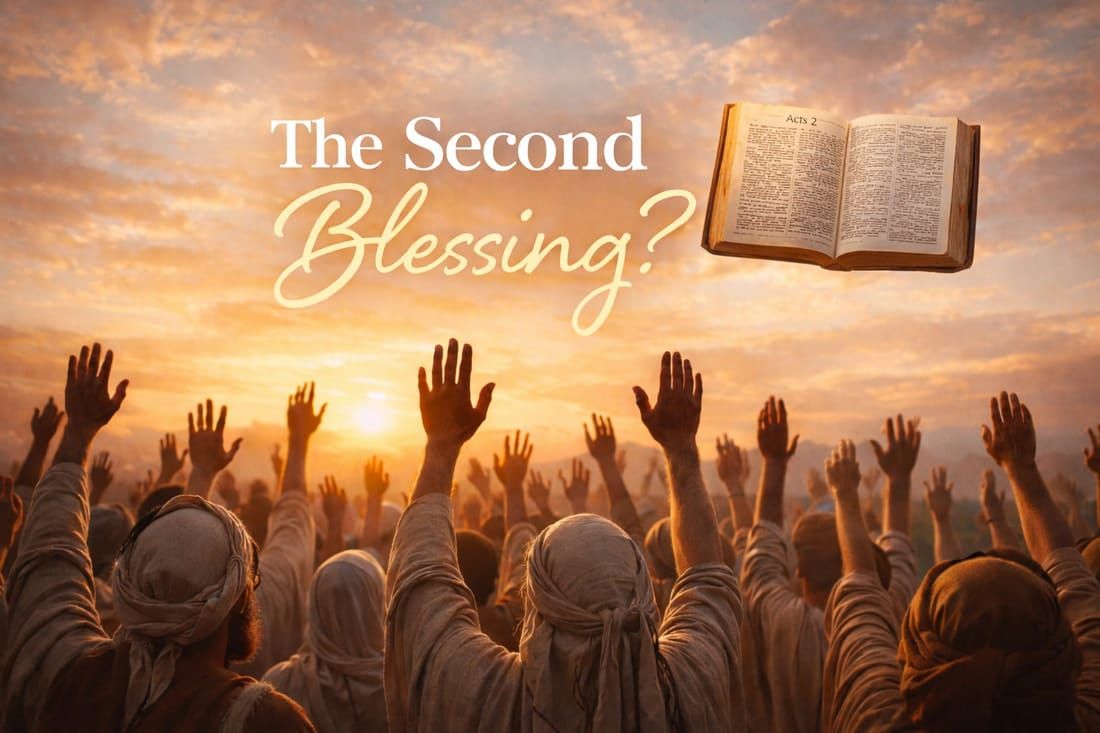
The Second Blessing?
Article #9 on Baptism
Is the Baptism of the Holy Ghost a Second Work of Grace?
Any doctrine that contradicts Scripture is dangerous, even if it is promoted by godly men who are renowned in Church History. John Wesley, Andrew Murray, A.B. Simpson, Duncan Campbell, D.L. Moody, and R.A. Torrey all believed in the Second Blessing. This name has stuck to their interpretation of the baptism of the Holy Ghost because it accurately conveys their teaching: the first blessing is bestowed upon sinners when they are saved in a new birth experience by repenting and believing in the Gospel, and the second blessing is bestowed upon believers in a post-conversion experience called the baptism of the Holy Ghost.
savedbaptized with the Holy GhostDuncanCampbell
regeneratedbaptized with the Holy SpiritR.A. Torrey
conversionregenerationa second blessingA.B. Simpson
second blessingregenerationthe baptism with the Holy SpiritR.A. Torrey
Proponents of this view passionately emphasize that the baptism of the Holy Ghost is a definite experience subsequent to salvation that will suddenly bring more blessing and fullness to Christians, like a second work of grace in a noticeable increase of power. Believers will be attracted to this message if they feel that such things were not provided for them through their conversion to Christ by the Gospel on the day of their salvation. We will examine these claims through the lens of Scripture. Do you believe in the Second Blessing?
1 Blessing, 2 Blessings, or All Blessings?
The Bible is very clear on this point. There is no such thing as the Second Blessing. God is not keeping back any blessings from people that are truly saved. There is no such thing as a subcategory of Christians who are blessed with salvation but deprived of other blessings.
who hath blessed us with all spiritual blessings in heavenly places in Christ
Notice how Paul speaks of the blessings that have been bestowed upon the Christians at Ephesus in the past tense. They were “blessed” upon being born again. All true Christians are “blessed” with “all spiritual blessings in heavenly places” because we are “in Christ” (Eph. 1:3). This makes perfect sense. All the blessings of the Godhead are in Christ. God could not have given to us anything or anyone more blessed than the Person of Christ (Jn. 3:16). All the treasures of Heaven are vested in Christ (Col. 2:2-3). Therefore, by virtue of being in Christ legally and positionally, all believers have access to “all” the blessings of God (Eph. 1:3).
Converted, Saved, and Regenerated but Lacking the Fullness of the Holy Spirit?
The Bible is very clear on this point. God is not keeping back any portion or part of the Holy Spirit from people who have been born again. This is impossible! All believers received the fullness of Christ and the fullness of the Holy Spirit upon being saved and spiritually joined to the Body of Christ (1 Cor. 12:13).
Which is His body, the fulness of Him that filleth all in all
Spiritallbaptizedbody
Getting spiritually “baptized into Christ” is a plunging into the whole universe of salvation (Gal. 3:27-29). Are you in Christ? Then it is enough. “For in Him dwelleth all the fulness of the Godhead bodily.” (Col. 2:9). But things get really confusing when preachers contradict Scripture by creating a subcategory of Christians who are a part of the Body of Christ and yet don’t have the fullness of the Spirit. Compare Ephesians 1:22-23 and 1 Corinthians 12:13 to the following quotes.
it isthe incoming of Christ Himself in fullness
A.B. Simpson
fullness powerA.B. Simpson
and being filled with the SpiritA.B. Simpson
and beingfilled with the SpiritDuncan Campbell
Conversion to Christ by regeneration happened through the baptism of the Holy Ghost in the Book of Acts. Three thousand Jews got “baptized” in Acts 2:37-41 on the Day of Pentecost. They were getting “saved” through a “remission of sins” as they were repenting and believing in the Gospel, and thus they received “the gift of the Holy Ghost” (Acts 2:38, 40). A few days later, five thousand more Jews got saved by the same means in Acts 4:4. This is why the Hebrew believers accepted “the Doctrine of Baptisms” as one of the most principle salvific doctrines of Christ (Heb. 6:1-2).
Other races of people eventually started getting saved in exactly the same way: the Samaritans (Acts 8), the Gentiles (Acts 10-11), the Galatians, the Philippians, & the Corinthians (Acts 13:48, 52, 16:14-15, 30-34, 18:8, 19:9). How did all these Gentiles become a part of the Body of Christ? “For by one Spirit are we all baptized into one Body, whether we be Jews or Gentiles, whether we be bond or free; and have been all made to drink into one Spirit.” (1 Cor. 12:13). The common denominator here is that water baptism physically and symbolically demonstrates the saving work of a spiritual baptism.
We don’t have to form our own opinions about the Book of Acts. The apostles took time to explain what was happening by describing the saving work of a spiritual baptism in the Epistles of the New Testament. Paul explained that when people are spiritually “baptized” they are experiencing and personal death, burial, and resurrection by the power of the Gospel (Rom. 6:1-7, Gal. 2:20, 6:14). And in this personal death, burial, and resurrection, the same people are experiencing a spiritual “circumcision” of heart so that they can become truly Jewish inwardly (Col. 2:9-13, Gal. 3:27-29, Rom. 2:25-29, Deut. 30:6, Jer. 31:33-34).
Everyone was getting saved when they were baptized by the Holy Ghost as they repented and believed in the Gospel. However, some people get confused about this because we know that the apostles (among others) were already saved before the Day of Pentecost (Jn. 8:42, 47, 17:6; John 17:11-14, 16). Jesus Christ clearly said, “They are not of the world, even as I am not of the world.” (Jn. 17:16). But the same thing could be said about all the saints in the Old Testament (Heb. 11:1-40). They were all born again too (Gal. 4:29, Rom. 9:6-8, Jn. 1:47, 2 Cor. 6:16; Ps. 51). You may remember how Nicodemus should have already known what it means to be born again (Jn. 3:10-11).
Understanding these things will lead us to ask the right questions about the baptism of the Holy Ghost on the Day of Pentecost. If the apostles were saved before and after Pentecost, then what was the baptism of the Holy Ghost for them? If the apostles were born again before and after Pentecost, then what was the baptism of the Holy Ghost for them? Being saved under the canopy of the Old Testament is different than being saved under the canopy of the New Testament. The apostles were born again through the powers of the Old Testament, and then they were born again through the powers of the New Testament. We are looking at a transition from the O.T. to the N.T. on the Day of Pentecost.
The New Testament cannot be enforced until after the death of the Testator (Heb. 9:16-17). Moreover, after the resurrection, it was “necessary” for Jesus Christ to ascend into Heaven. He had to go there to “appear in the presence of God for us” (Heb. 9:23-24). The ascension plays a part in how the blood has “enjoined” the New Testament to believers (Heb. 9:18-24). Finally, we are told that Jesus Christ “sat down on the right hand of the Majesty on high” (Heb. 1:3). His Kingdom is not of this world (Jn. 18:33, 36)! The Kingdom of the Messiah cannot begin until the son of David was sitting on the Throne of Heaven in a human body (Jn. 18:33, 36; Rev. 12:10; Jn. 16:7-11). This momentous occasion was marked by the outpouring of the Holy Ghost on the Day of Pentecost, as Peter said, “God hath made that same Jesus…both Lord and Christ” (Acts 2:32-36; Jn. 14:16-17, 15:26, 16:7). All this makes sense of the Book of Acts.